
My primary areas of research are paleoclimatology and dendrochronology with an especial focus on hydroclimate variability. More particularly, I use tree rings to understand past and present shifts in water: its supply, its frequency, and its overall trends through time. Through examining and reconstructing past climate, I provide context for current weather patterns and for potential future ones under a warming climate. As an early career researcher, I predominantly study questions involving inter- and intra-annual precipitation variability, frequency and return-intervals of droughts and pluvials, and changes in river streamflow.
My previous research has focused on the Sierra Nevada and western United States. For example, during my Master’s, I reconstructed Truckee River streamflow, extending our knowledge of the basin by over 400 years. That study revealed a steady decrease in river flow and an overall decrease in pluvial lengths starting in the 1850s, findings which may have large consequences for future water management. Through this project and others, I have a strong grounding in assessing tree-ring climatological signals and reconstructing past hydroclimate.

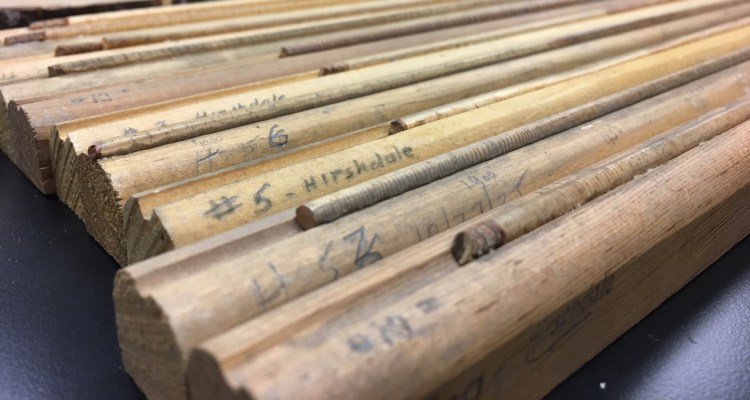
My current doctoral research has applied these skills to the U.S. Midwest, a landscape especially challenging for dendrochronological research due to its extensive human modification. With climate change making weather more uncertain, I am interested in deepening our knowledge of past and current sub-annual shifts in regional hydroclimate, especially the seasonality and variability of precipitation. These reconstructions employ process-based modeling and newer metrics such as earlywood and latewood. In addition, I am applying new tree-ring techniques to understand and reconstruct Iowa river basin streamflow, a project aimed to assist with future flood management.
My future research will continue to focus on questions of past climate. In particular, I wish to explore further how tree rings can reflect and reconstruct non-traditional hydroclimate variables such as vapor pressure deficit and wet-day frequency. These studies, in turn, I hope to use to provide context for current trends and variability under a warming climate with analogues from the past. Further, I would also like to focus on less-studied regions such as the U.S. Great Basin which would benefit from long-term climate perspectives.
Publications:
- Gangopadhyay, S., et al. (in review). Potential Flood Events in the Lower Missouri River Basin Over Multiple Centuries Identified Using Tree-ring Based Multi-Model Streamflow Reconstructions. Water Resources Research.
- Rhee, G., et al. (2025). Topographic setting drives the imprint of the Madden-Julian Oscillation (MJO) on tree growth in the northern Sierra Nevada. International Journal of Climate. https://doi.org/10.1002/joc.70162
- Harris, V., and Csank, A. (2023). A New 500-Year Reconstruction of Truckee River Streamflow. Dendrochronologia, 79. https://doi.org/10.1016/j.dendro.2023.126093
- Harris, V. (2021). Trees and the Truckee River: Our Past, Our Future, and George Hardman (M.S. Thesis). Reno, NV: University of Nevada, Reno.
- Harris, V., et al. (in process). Influence of sub-annual precipitation and vapor pressure deficit on earlywood and latewood growth of Quercus alba. Journal of Geophysical Research: Biogeosciences.
 Victoria Harris